Cold Plunge Features: Types, Materials, and Buying Guide
- Share
- Issue Time
- Nov 18,2026
Summary
A practical cold plunge buying guide for importers: chiller and circulation functions, temperature control, water treatment, five common tub materials, and landed cost checks.
Published: November 18, 2026 · By Shirley · Category: Blog
If you are sourcing cold plunge suppliers and plan to import cold plunge tubs from China, this guide walks through the features, cooling configurations, and materials commonly found on the market today. Skimming the feature checklist and the material comparison table below will help you narrow down the options and make the next conversation with a supplier more productive.
What Features Does a Cold Plunge Have? What a Complete System Is Made Of
A cold plunge with active cooling usually consists of four parts: the tub body, the chiller, the water circulation system, and the temperature control system. Suppliers add filtration, disinfection, smart control, and heating on top of that. For buyers, understanding this structure first makes it easier to decide which features are essential, rather than comparing quotations line by line.
1. Cooling Function: The Chiller
The chiller lowers the water temperature and keeps the system at the set point, so it has the biggest effect on how the product feels in daily use.
For commercial buyers, cooling capacity is one of the parameters that deserves the closest attention. The points below are the ones to confirm before requesting a quote:
Cooling power and the water volume it is rated for
The lowest set water temperature
The time needed to drop from the starting water temperature to the target temperature
Cooling performance at different ambient temperatures
Whether continuous operation is supported
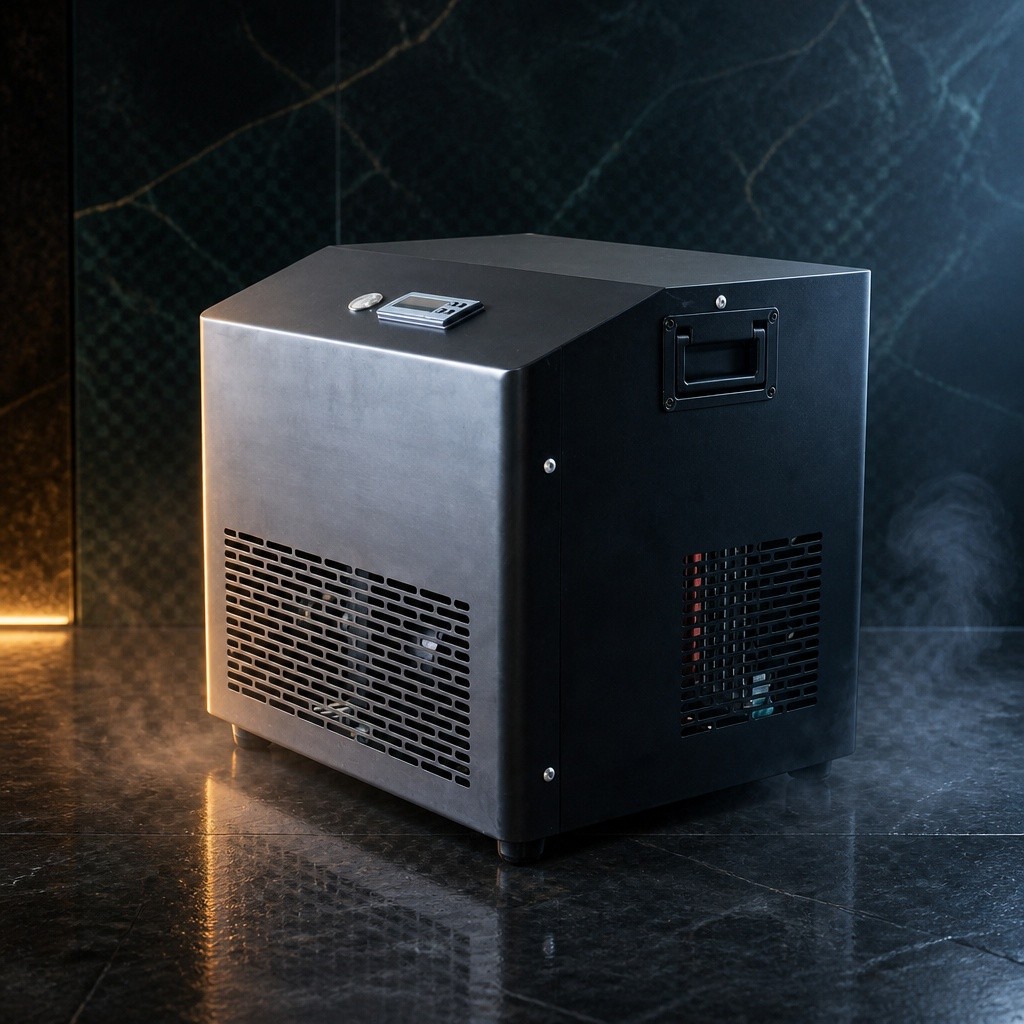
Freestanding water chiller: dark metal housing with a digital control panel on top and ventilation grilles on the front and side
Note that the lowest water temperature is not the same as the actual cooling speed. Two products can carry the same minimum temperature and still cool at different rates, because cooling capacity, tub volume, and insulation structure all differ.
So do not judge a chiller by its minimum temperature alone. Weigh it together with the climate of the target market, the tub volume, and how often the product will be used.
2. Water Circulation and Filtration System
The circulation system uses a pump to move water through the piping and the filter, which helps remove suspended particles and keeps water from sitting still in one part of the tub.
Typical components include the circulation pump, the filter, and the connecting lines. For gyms, hotels, and recovery studios, water maintenance matters a great deal.
Filtration and disinfection are two different things, though. A standard filter mainly removes particles and cannot safeguard water quality on its own. If the product targets high-frequency use, confirm whether additional water treatment is needed, and check the filter replacement interval, consumable cost, and daily cleaning routine.
These details shape the maintenance experience of your end users and the long-term convenience of the product. For the design logic behind circulation, see our guide to the spa circulatory system; for filter consumables, work through the spa filter cartridge buying guide point by point.
3. Temperature Control System
The temperature control system lets the user set a target water temperature and read the current one, and it is the interface users touch most often.
Products may use a digital control panel, and some support Wi-Fi or app control. For export models, the control system also has to match local habits: buyers in the United States tend to work in Fahrenheit, while Europe generally uses Celsius.
At the sourcing stage, confirm temperature unit switching, the settable range, running status display, and fault alerts. If the product targets the mid-to-high end, ease of operation and the panel design can become part of the differentiation. For control board and electrical component selection, see our bathtub electrical control system guide.
4. Water Disinfection
Some cold plunges include UV or other water treatment equipment to help control microorganisms in the water.
For commercial settings, this is a useful reference point when evaluating a configuration. Keep in mind that UV treatment, water filtration, and water disinfection are not the same function; the technologies work differently and suit different conditions.
Confirm which technology is used, whether it needs to be combined with other treatment, and how the equipment is maintained. For the safety boundaries of ozone and UV sanitizing, see our notes on bathtub ozone systems.
5. Other Optional Features
Beyond the core configuration, a cold plunge can add the following:
Wi-Fi / App control: lets users check or adjust some operating parameters from a phone, depending on the control system.
Timed operation: runs selected functions on a schedule set in the device design.
LED lighting: improves the look of the product and the experience of using it.
Insulated cover: reduces heat exchange at the water surface and keeps debris out of the tub.
Safety protection: over-temperature, leak, or other protection depending on the design.
More features do not automatically make a product more competitive. For an entry-level commercial product, stable cooling, circulation, and temperature control may already be enough; for a mid-to-high-end brand built around smart features, app control, automatic water treatment, and better insulation are worth considering. For how covers and supporting parts fit together, see our guide to the spa peripheral support system.
Cold Plunge Material Comparison: Strengths and Limits of Five Common Options
The five materials most often used for cold plunges are PVC, fiberglass, acrylic, stainless steel, and rotomolded plastic. They directly affect appearance, weight, durability, insulation structure, and overall sourcing cost, and no single material is better in every scenario.
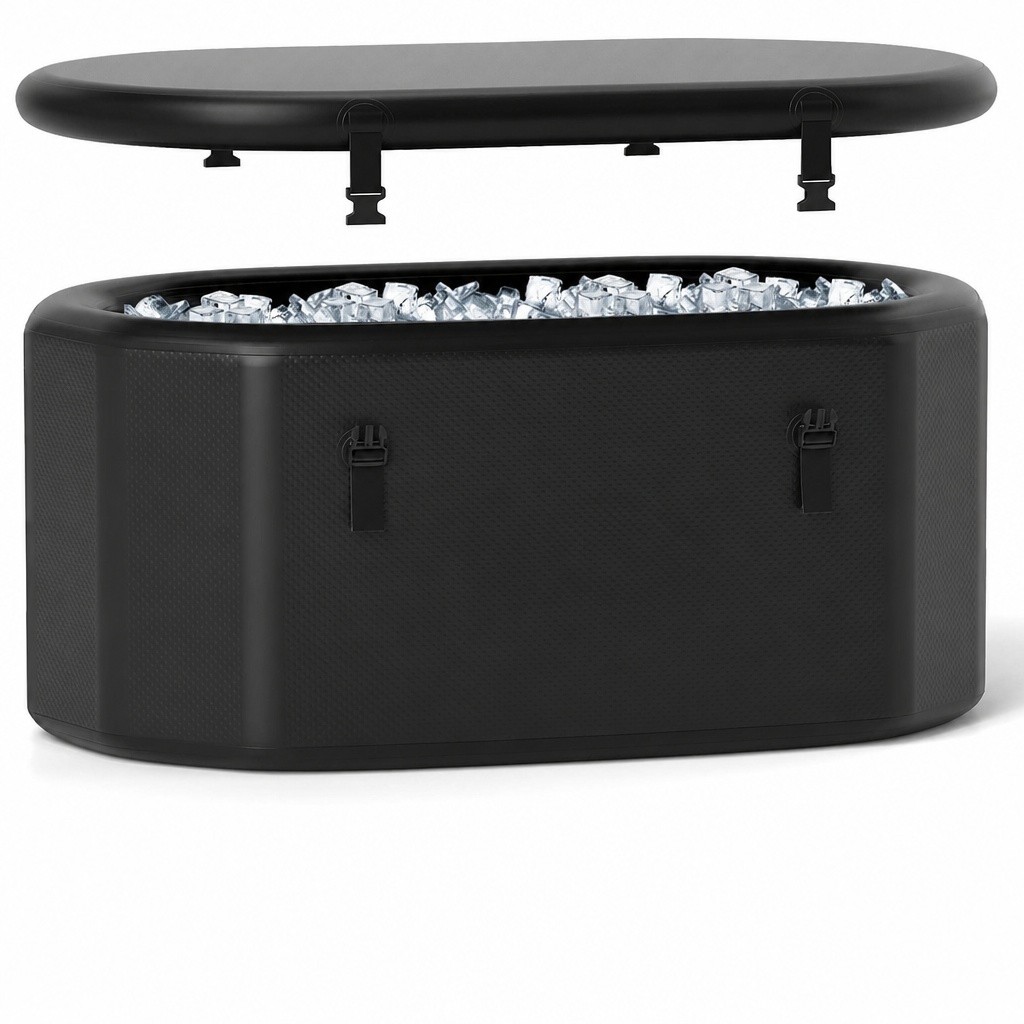
Black portable inflatable cold plunge tub with a removable insulated cover and ice visible in the water
| Material | Main advantages | Points to watch | Typical positioning |
|---|---|---|---|
| PVC | Lightweight, easy to ship, relatively low sourcing cost | Structure, insulation, and durability depend on the specific design | Portable products |
| Fiberglass | Solid overall structure, flexible styling | Weight, surface maintenance, and production process all need consideration | Residential and mid-range products |
| Acrylic | Smooth surface, refined appearance, many color and shape options | Higher cost, usually needs a supporting frame | Mid-to-high-end residential products |
| Stainless Steel | Sturdy, clean look, relatively easy to clean | Cost, weight, and insulation structure need close review | Commercial and high-end products |
| Rotomolded Plastic | Flexible one-piece forming, good impact resistance | Wall thickness, surface finish, and insulation vary between products | Residential and commercial products |
There is no absolute ranking among cold plunge materials. Acrylic usually puts more emphasis on appearance and surface feel, but that does not make it a better fit than rotomolded plastic for every outdoor commercial setting. Stainless steel is sturdy and easy to clean, yet without adequate insulation it can still increase heat exchange and affect how hard the chiller has to work.
That means the tub material is only part of the picture: the insulation layer, base support, shell structure, and drainage design deserve equal attention.
For import sourcing, packing dimensions, shipping weight, and container loading efficiency are also worth checking. Two products with similar unit prices can end up with very different landed costs.
How to Choose a Cold Plunge: Four Steps from Positioning to Landed Cost
Start by defining the target market and product positioning, then confirm material, features, and cooling configuration step by step, and finally bring shipping and compliance requirements into the total cost.
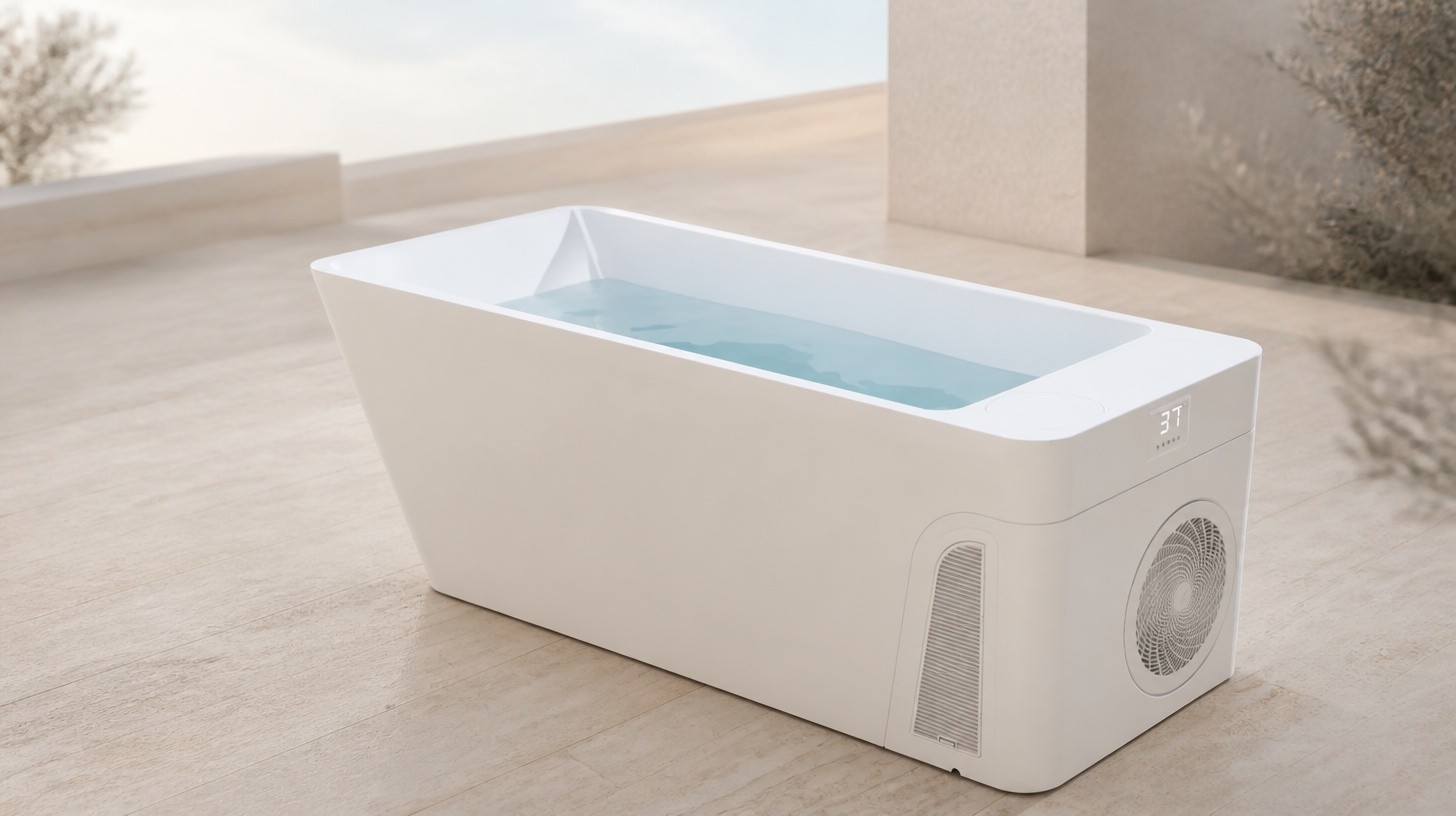
White integrated cold plunge tub with a digital display and a ventilation area at the front
1. Define the Product Positioning First
Demand for cold plunges differs from market to market. Before sourcing, clarify who the end customer is and where the product will be used, then choose the material, feature set, and cooling approach that match that positioning.
2. Choose a Built-in or an External Chiller
A built-in chiller integrates the cooling unit into the product structure, which gives a cleaner overall look and can simplify installation. At the sourcing stage, confirm heat dissipation clearance, service access, and overall dimensions so maintenance does not become difficult later.
An external chiller keeps the cooling unit separate from the tub, which makes equipment layout more flexible and easier to adapt to a specific design. It does require additional piping connections, floor space for the unit, and attention to visual coordination. For the structural differences between the two approaches, see our cold plunge tub vs chiller comparison.
3. Match Cooling Capacity to Water Volume and Usage Frequency
Cooling capacity cannot be judged from tub size alone. A large water volume, a hot ambient temperature, or frequent use all put a heavier load on the cooling system.
When requesting a quote, give the supplier the tub volume, the target water temperature, the expected usage frequency, and the installation environment.
4. Calculate the Full Sourcing Cost
For importers and distributors, the unit price is only one part of the cost. Packing, freight, import duties, installation, consumables, and after-sales spare parts all belong in the calculation.
Cold plunges with a cooling unit especially need the voltage, frequency, plug, and related electrical requirements confirmed against the target market. If the product will be sold in several countries, check the applicable certification and compliance requirements one by one, so the configuration is not found unsuitable only after the goods arrive.
Takeaways: Five Points to Confirm Before Sourcing a Cold Plunge
Know the positioning first. Define the target market, the use case, and the expected price and feature requirements before deciding on material, features, and cooling approach.
Match the cooling. Cooling capacity has to fit tub volume, target water temperature, and usage frequency; the minimum temperature does not show how fast the water actually cools.
Treat water care as separate steps. Filtration, disinfection, UV, and ozone are different stages, and high-frequency commercial use means confirming consumable cost and maintenance together.
Judge the material as a whole. Beyond the tub material itself, the insulation layer, base support, shell structure, and drainage design all affect how the product performs.
Count the landed cost. Packing, freight, duties, installation, consumables, and electrical and certification requirements are all part of the full sourcing cost.
Looking Ahead: From a Sourcing Checklist to a Workable Product Plan
When moving a cold plunge project forward, define the target market and product positioning first, then check material, features, cooling capacity, shipping method, and the voltage, frequency, plug, and certification requirements of the target market one by one.
Putting these items into a comparison table reduces back-and-forth, and makes it easier for suppliers to quote options you can compare directly.
Work With Us
Hydrorelax supplies hot tubs, spas, and related accessories to commercial buyers. If your team is developing a cold plunge line, send us the target market, expected price, and feature requirements, and we can review the right configuration together.
Cold Plunge FAQ
Does a cold plunge always need a chiller?
For a commercial product that has to deliver continuous cooling and stable temperature control, the chiller is usually the core component. The actual cooling capacity depends on tub volume and target water temperature.
Which is better, a built-in or an external chiller?
A built-in unit puts more emphasis on overall appearance and integrated design, while an external unit offers more flexible equipment layout. The choice should come down to installation space, maintenance needs, and product positioning.
Is a more powerful chiller always better?
Not necessarily. Cooling capacity has to match tub volume, target water temperature, and usage frequency. Too little capacity means long cooldown times, while over-specifying adds sourcing cost.
How should I choose the material for a cold plunge?
Each of the five common materials has its own fit: PVC is light and lower cost and is mostly used for portable products; fiberglass offers a solid structure; acrylic looks refined but costs more; stainless steel is sturdy and relatively easy to clean; rotomolded plastic is formed in one piece and resists impact. Weigh the insulation layer, support structure, and shipping cost together with the material.
What information should I give a supplier when requesting a quote?
Provide the tub volume, target water temperature, expected usage frequency, installation environment, and the voltage, frequency, plug, and certification requirements of the target market. The more complete the information, the easier it is for the supplier to quote options you can compare directly.
· · ·