DIY Hot Tub Cover: Is It Worth It?
- Share
- Issue Time
- Sep 4,2026
Summary
Compare DIY vs. commercial spa covers by price, R-value, lifespan, insulation, maintenance, safety, and long-term cost to make a smarter hot tub cover choice.
When your old spa cover reaches the end of its service life and a replacement cover is not cheap, many owners start asking: can I make one myself?
When searching online for DIY spa cover solutions, you will often find two completely different opinions in the comments: half of people say, "That's a smart idea," while the other half say, "Wait until you see your energy bill."
So, does a DIY spa cover always fail?
The answer is not that simple. Under certain conditions, a DIY spa cover can be a practical option, but its suitable application range is much narrower than most people expect.
This article compares the real costs of both options - actual material costs, insulation performance loss, maintenance effort, and hidden expenses that are often overlooked - to help you make a more informed decision. Hydrorelax has long been engaged in the production and supply of spa accessories, and the comparison below is based on how these products are actually built and used.
Common DIY Spa Cover Options: What Can Each of the Three Approaches Actually Do?
There are three mainstream DIY approaches: a waterproof tarp, a wooden slat roll-up cover, and a foam core plus vinyl composite structure. Costs range from $50 to $300, and the gap in insulation capability between them is wide.
Waterproof Tarp Cover
This is the most common low-cost DIY solution, with a cost of under $100. A waterproof tarp is placed directly over the hot tub, or a PVC pipe frame is built underneath to support the tarp and prevent water accumulation.
Advantages: quick installation, almost no technical barrier.
Disadvantages: provides almost no insulation, and mainly functions as protection against dust and rainwater.
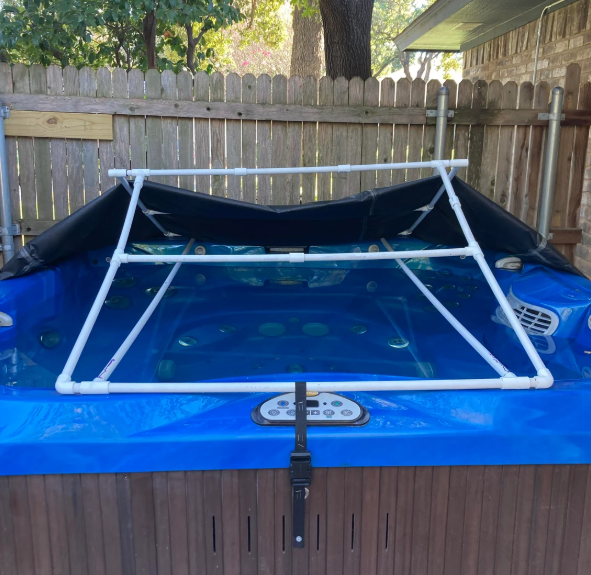
DIY PVC frame and tarp hot tub cover on an outdoor spa
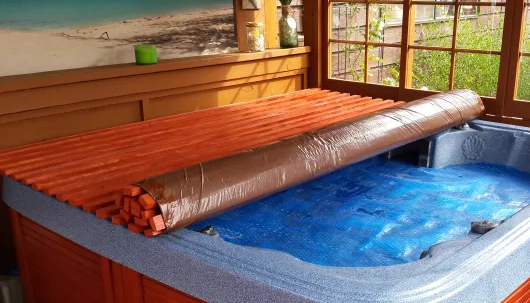
Wooden Slat Roll-Up Cover
The cost is approximately $50-$60. This design uses pine or cedar slats connected together, with a thin waterproof layer, foam pad, or reflective aluminum film attached underneath.
Advantages: easy to store, more visually appealing.
Disadvantages: relatively heavy, provides no real insulation, and requires regular sanding and repainting maintenance.
DIY wooden slat roll-up spa cover partially rolled on a hot tub
Foam Core + Vinyl Composite Structure
This is a more advanced DIY approach and the closest option to a commercial spa cover. The cost is approximately $150-$300. The structure typically uses foam boards sandwiched with plywood, sealed with a thick plastic membrane on the outside, wrapped with vinyl fabric, and connected with hinges in the middle.
Advantages: provides the best insulation performance among DIY solutions.
Disadvantages: requires higher fabrication skills.
Experienced DIY users may further upgrade this structure by filling a wood frame with high-density foam, applying fiberglass and epoxy resin layers on both sides, and adding an outer wood veneer or aluminum panel finish. The total cost can reach $700-$870, approaching commercial-grade quality, but the construction difficulty and safety requirements increase significantly.
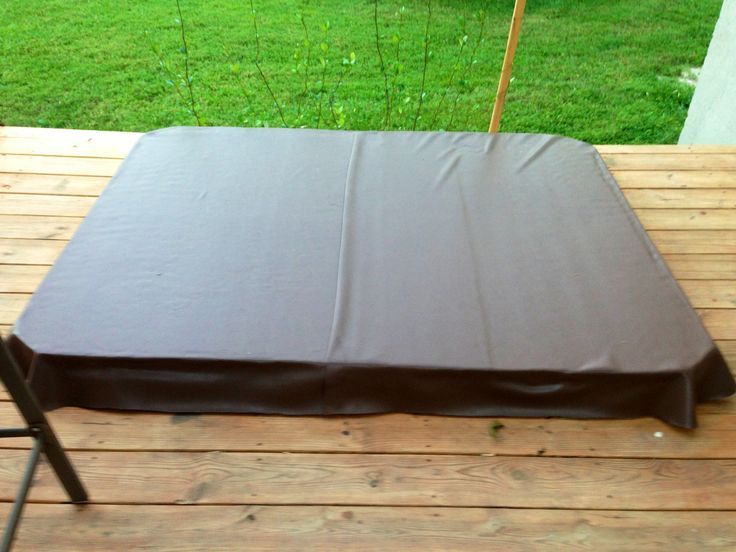
DIY foam core and vinyl spa cover with center hinge seam
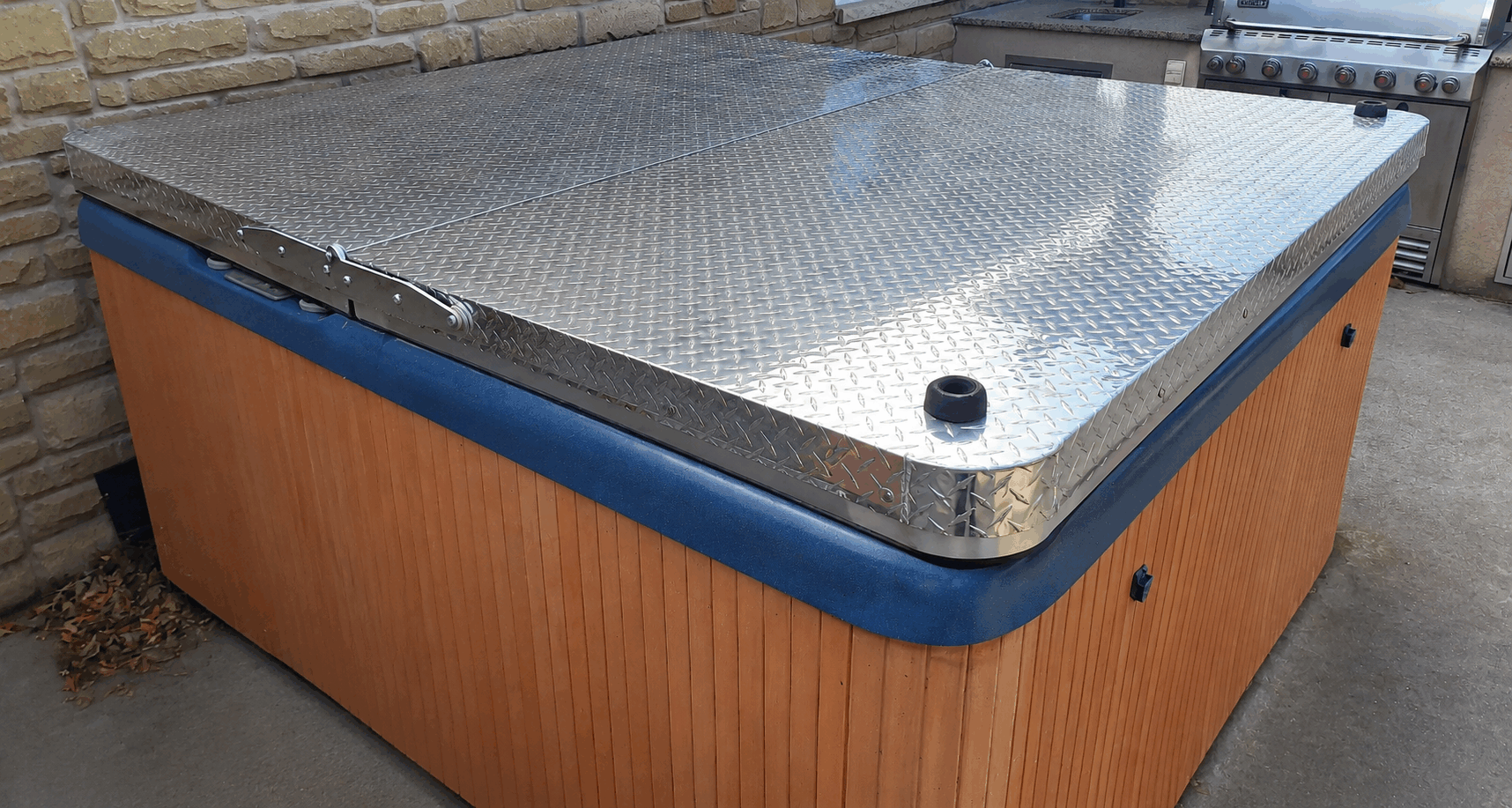
DIY hot tub cover with aluminum panel outer finish and hinge
DIY vs. Commercial Spa Covers: Where Does the Cost Difference Actually Appear?
The initial cost of a DIY cover is genuinely lower, but once expected lifespan, R-value, maintenance, and energy consumption are added to the calculation, the gap narrows and can even reverse.
| DIY | Commercial Spa Covers | |||
|---|---|---|---|---|
| Wooden Slat Roll-Up Cover | Waterproof Tarp Cover | Foam Core + Vinyl Composite Structure | ||
| Initial Cost | $50~60 | Under $100 | $150-300 | $300-800 |
| Expected Lifespan | 1-3 years | Less than 1 year | 2-4 years | Approximately 5-7 years |
| R-Value | Close to zero | Not quantifiable | R-8 to R-20 | |
| Safety Locking Straps | No | Generally unavailable | Yes | |
| Additional Maintenance Cost | Medium (regular sanding and repainting required) | Low | Medium | Low |
| Energy Consumption Increase | High | Medium | Baseline | |
When calculated based on the average annual cost, a commercial spa cover does not necessarily cost more than a DIY solution. The main cost difference appears during the first two years. After that, commercial products begin to demonstrate their advantages in durability, insulation performance, and long-term cost efficiency. For a breakdown of real service life and cost control, see this after-sales and cost analysis.
The Real Problems with DIY Spa Covers: What Are the Four Limitations You Cannot Design Around?
The weaknesses concentrate in four areas: insulation performance, material aging, safety, and structural stability. None of them can be solved simply by spending more time on the build.
Core Issue 1: Reduced Insulation Performance
This is where the biggest gap between DIY solutions and commercial products appears.
The insulation performance of commercial spa covers is measured by R-value. Common products typically achieve R-8 to R-20, relying on a combination of high-density EPS foam cores, heat-sealed vapor barriers, and marine-grade vinyl outer covers.
The biggest limitation of DIY solutions is not only the lower R-value, but also the inability to accurately measure and consistently maintain insulation performance. If the foam panels are not properly sealed, water vapor can penetrate over time, causing the insulation performance to gradually decline.
Insufficient insulation directly leads to higher energy consumption. Based on a typical outdoor hot tub with a heating power range of 1,500W-6,000W, a poorly insulated cover may increase electricity costs by several dozen dollars per month, with an even greater impact in colder climates. Selecting cover materials for winter-ready markets covers this point in more detail.
Core Issue 2: Accelerated Material Aging in Chemical Environments
Spa covers are constantly exposed to chlorine or bromine vapor, combined with outdoor UV exposure. As a result, the lifespan of most DIY materials is significantly reduced.
For commercial spa covers, the foam core is typically processed with heat-sealing technology to create a vapor barrier that helps protect against chemical vapor penetration and corrosion. DIY spa covers often rely on thick plastic film for sealing, and the sealing performance usually cannot meet factory-level standards, which significantly shortens their service life. The difference in this step is visible in how manufacturers produce spa covers.
Furthermore, low-cost waterproof tarps exposed to direct sunlight and disinfectant environments may crack and develop leaks in less than one year. Once sealing fails, the foam absorbs moisture and the cover starts to bubble - see hot tub cover bubbles: causes and prevention.
Core Issue 3: Safety Risks and Construction Challenges
Commercial spa covers typically come with a locking strap system as standard. This system not only prevents the cover from shifting, but also helps reduce the risk of children accidentally falling into the water. DIY solutions generally cannot replicate the same level of safety and often rely entirely on adult supervision. For strap material and length selection, see the spa cover straps selection guide.
A waterproof tarp loosely placed over a hot tub without secure fastening can become a potential hazard. If a child or adult falls onto the cover and becomes entangled, self-rescue may become difficult. In some regions, this type of setup may be considered a safety violation by insurance providers, potentially affecting insurance claims.
DIY spa covers also have their own construction safety requirements, especially advanced composite designs involving fiberglass and epoxy resin. Fiberglass dust inhalation may pose health risks, requiring proper protective equipment such as respirators and safety goggles throughout the process. Epoxy resin, especially fast-curing formulations, often has a working window of only 20-30 minutes. Once mistakes occur, the entire surface may need to be sanded down and rebuilt, and the curing process can also release volatile organic compounds (VOCs).
This is not simply a basic hardware assembly task. It requires specialized skills, experience, and proper safety procedures.
Core Issue 4: Structural Stability Is Difficult to Maintain Over Time
Modern commercial spa covers typically incorporate C-channel steel reinforcement inside the foam core to improve structural support and extend the service life of the cover.
Most DIY spa covers do not include this type of internal steel reinforcement. Over time, the cover surface may gradually bend, deform, and lose its original supporting function.
Once the structure becomes unstable, the cover may no longer provide effective protection, and contaminants can enter the hot tub water, negatively affecting water quality. Fit against the tub rim deteriorates at the same time, which is addressed in hot tub cover installation and proper fit.
When Is a DIY Spa Cover a Suitable Option: Which Three Situations Actually Justify It?
An indoor installation, a setup where insulation is not the primary requirement, or a builder with professional fabrication skills. Meeting one of these makes a DIY cover practically worthwhile.
Indoor Hot Tub Installation
Indoor environments are not exposed to direct sunlight, rain, frost, or extreme temperature changes. As a result, the cover has lower requirements for weather resistance and material durability, making DIY solutions more practical.
When Insulation Is Not the Primary Requirement
If the hot tub is kept at room temperature or low temperature most of the time and only heated occasionally before use, the cover's insulation performance has a limited impact on daily operating costs.
In this situation, the main purpose of a DIY cover is to block dust, leaves, and rainwater. A waterproof tarp cover may already be sufficient for this purpose.
When the Builder Has Professional Fabrication Skills
If the builder has professional experience in woodworking, sealant application, or foam processing, they may be able to create a cover with a complete structure and reliable sealing performance. Under these circumstances, a DIY spa cover can offer a reasonable cost-to-performance ratio.
Conclusion: When Should You Simply Buy a Commercial Spa Cover?
If your hot tub is installed outdoors, requires regular heat retention, is used in a household with children, or you simply do not want to rebuild or replace the cover every one or two years, the money saved by choosing a DIY solution will most likely be spent over time on higher energy bills and replacement materials.
If you have decided to purchase a professional spa cover, the key factors to evaluate are:
- Whether the R-value is clearly specified
- Whether the foam core density is sufficient
- Whether the supplier can provide custom sizing options to match your hot tub dimensions
These factors can vary significantly between products from different sources, so they are worth confirming carefully before placing an order. For sizing and replacement, see the hot tub cover measuring and replacement guide; the shape of the tub rim also affects cover construction, as explained in tapered vs non-tapered spa covers.
Looking Ahead: How Is Cover Selection Shifting from Price to Long-Term Cost?
More buyers are now making decisions based on annualized cost rather than first purchase price. Details that used to be treated as optional specifications - stated R-value, foam core density, locking strap configuration - are becoming firm requirements on the sourcing checklist.
For dealers and project buyers, this means verifiable data is more convincing than a lower quotation.
Work With Us: How Can We Support Your Spa Cover Sourcing?
Hydrorelax has been engaged in the production and supply of spa accessories since 2000. If you are looking for a stable and reliable spa cover source for your projects or retail business, feel free to contact us.
Simply provide your hot tub specifications, and our team can offer tailored purchasing recommendations. Buyers comparing bulk suppliers can also review our B2B spa cover manufacturer list.
Need a spa cover built to your tub dimensions?
Send us your hot tub specifications and we will advise on materials, R-value, and structure.