Hot Tub Controller and Control Panel Compatibility
- Share
- Issue Time
- Mar 31,2026
Summary
This article explains the compatibility between hot tub controllers and control panels, helping OEM buyers avoid malfunctions and reduce after-sales risks.
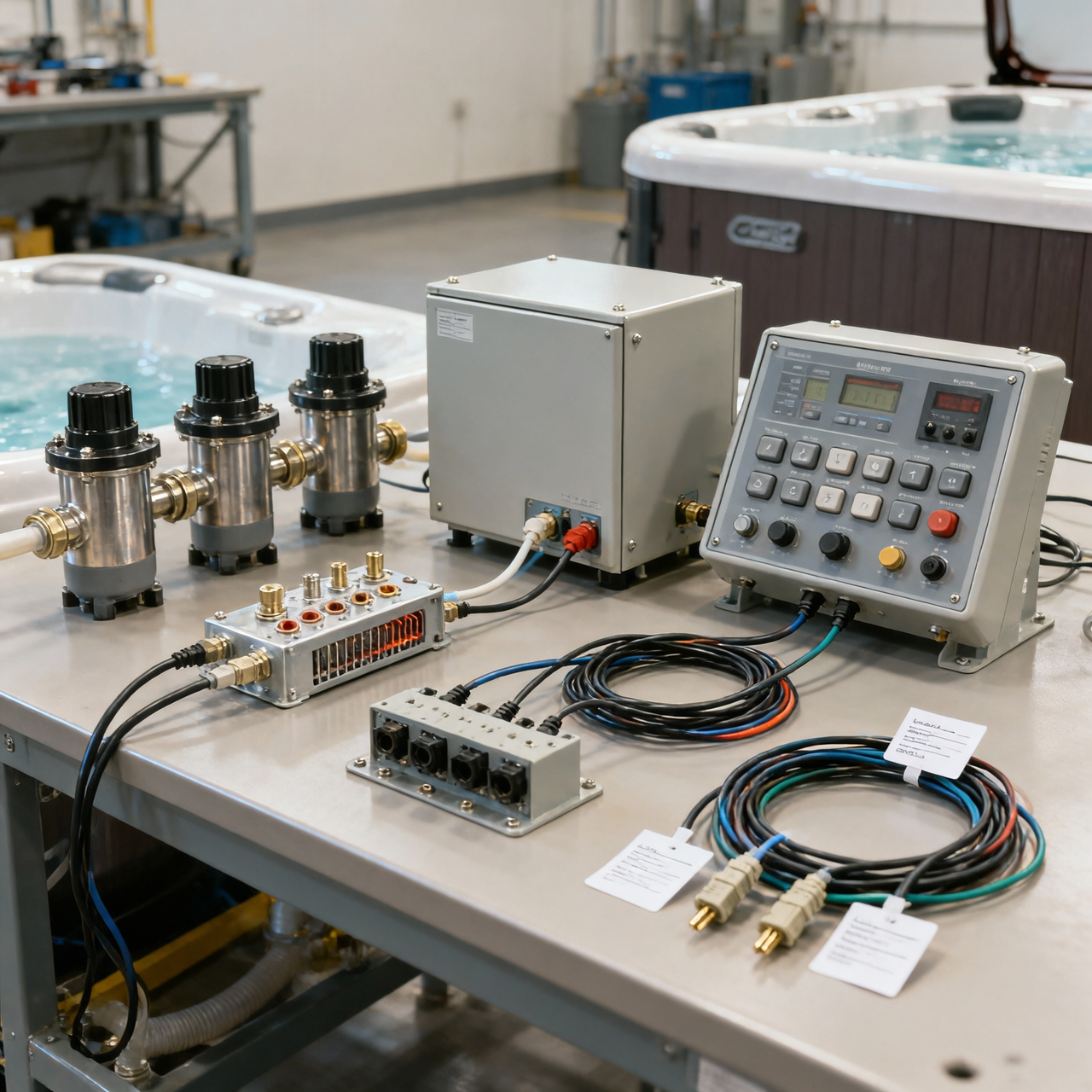
In the hot tub industry, many operational failures are mistakenly attributed to pumps, heaters, or wiring issues. In reality, a significant percentage of malfunctions originate from incorrect matching between the hot tub controller and the control panel.
For OEM manufacturers, spa brands, distributors, and professional installers, controller–panel compatibility is not a cosmetic or user-interface decision. It is a system-level engineering and procurement issue that directly affects production stability, certification compliance, and long-term service cost.
This article provides a professional, B2B-focused explanation of how hot tub controllers and control panels must be matched, what risks arise from incorrect pairing, and how OEM-level buyers should approach selection and replacement decisions.
Understanding the Hot Tub Control System Architecture
Before discussing compatibility, it is critical to understand how a hot tub control system is structured.
A complete control system consists of three primary layers:
Main Controller (Control Box)
The controller is the central processing unit of the spa. It manages power distribution, safety logic, sensor input, and device sequencing for pumps, heaters, blowers, lights, and auxiliary systems.
Control Panel (User Interface)
The control panel is the human–machine interface. It does not make decisions independently. Instead, it sends commands to the controller and displays system feedback based on predefined communication rules.
Peripheral Devices
These include pumps, heaters, ozone systems, UV units, lighting modules, temperature sensors, and flow switches.
From an OEM perspective, the control panel is not an accessory. It is a dependent terminal that must be fully aligned with the controller’s electrical logic, communication protocol, and firmware version.
Most Common B2B Questions About Controller–Panel Matching
Can any control panel be used with any hot tub controller?
No. Even if physical connectors appear similar, control panels are rarely interchangeable.
Differences may exist in:
Communication protocol
Signal voltage levels
Button logic mapping
Display command structure
Firmware compatibility
In many cases, a mismatched panel may power on, creating a false impression of compatibility. However, this often results in delayed failures such as unresponsive buttons, incorrect pump activation, heater lockouts, or persistent error codes.
What happens if the wrong control panel is installed?
For B2B operators, the consequences extend beyond a single malfunction:
Increased after-sales service calls
Misdiagnosis of controller failure
Unnecessary controller replacements
Field labor costs and downtime
Risk of certification non-compliance
From an OEM standpoint, these issues directly impact brand reliability and warranty exposure.
Why do some panels work partially but not fully?
Partial functionality usually indicates protocol-level mismatch rather than hardware failure.
Common symptoms include:
Basic functions working while advanced features fail
Pumps responding but heater control disabled
Display showing incorrect temperatures or icons
These problems are often incorrectly treated as software bugs or sensor issues, when the root cause is panel incompatibility.
Key Compatibility Factors OEM Buyers Must Verify
Communication Protocol
Most spa control systems use proprietary communication protocols. Panels designed for one platform are typically not compatible with others, even within the same brand across different generations.
OEM buyers must verify:
Exact controller platform
Supported panel models
Protocol revision compatibility
There is no true "universal" control panel in professional spa systems.
Voltage and Power Supply Logic
Control panels may be powered directly by the control board or through independent voltage regulation.
Using a panel with incorrect voltage requirements can result in:
Panel damage
Controller output failure
Intermittent system shutdowns
This is a critical but often overlooked factor during replacement sourcing.
Firmware and Software Version Alignment
Even when a panel model is officially compatible, firmware mismatches can prevent correct operation.
OEM best practice requires:
Locked firmware versions for mass production
Controlled upgrade paths
Clear documentation for service replacement
Unmanaged firmware variation is a common source of inconsistent field behavior.
Controller–Panel Matching in OEM Production
In mass production environments, consistency is essential.
Mixing control panels across different production batches can lead to:
Assembly errors
Functional test failures
Inconsistent user experience
Increased training complexity
Professional OEM manufacturers treat the controller, panel, and firmware as a single locked system package, not independent components.
This approach reduces variability and stabilizes both production and after-sales service.
Controller–Panel Matching in After-Sales Replacement
One of the most common service errors is replacing only the control panel without verifying controller compatibility.
From a B2B service perspective, correct replacement requires:
Confirming controller model and revision
Verifying supported panel list
Checking firmware compatibility
Testing full system functionality after installation
Replacing a panel based solely on appearance or connector type often leads to repeat service calls.
Best Practices for OEM Buyers and B2B Partners
To minimize risk, professional buyers should follow these principles:
Always identify the exact controller model and generation
Use manufacturer-approved compatibility lists
Avoid panels marketed as "universal"
Maintain system-level documentation for each model
Treat controller and panel as a matched pair
These practices significantly reduce long-term service cost and operational risk.
Why System-Level Thinking Matters
A control panel alone does not define a hot tub's performance. However, an incorrectly matched panel can destabilize the entire system.
For OEMs and professional buyers, controller–panel compatibility is not a minor detail. It is a core engineering and procurement decision that affects reliability, compliance, and scalability.
Conclusion
Understanding hot tub controller and control panel compatibility is essential for OEM manufacturers, distributors, and professional installers.
Correct matching:
Improves system stability
Reduces after-sales failures
Protects certifications
Enhances long-term brand value
In the B2B spa industry, the difference between selling components and delivering reliable systems lies in how well the control architecture is managed.
Hydrorelax specializes in the manufacturing and supply of spa bathtub controllers and control panels. If you have any procurement needs or compatibility questions, feel free to contact our team at any time!
You can also learn more about the specialized knowledge related to whirlpool bathtub components.