Hot Tub OEM Assembly: System Architecture, Dependency Chains, and Production Logic
- Share
- Issue Time
- Mar 20,2026
Summary
This guide explains hot tub OEM assembly from a system perspective, focusing on core architecture, dependency chains, and production logic to ensure reliability and efficiency.
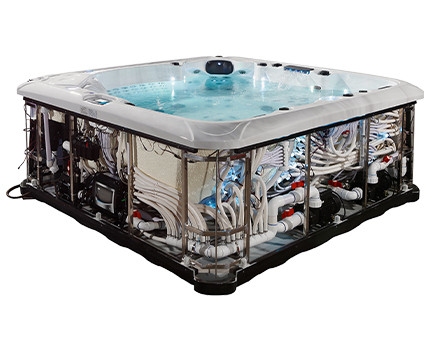
For an OEM hot tub manufacturer, the real challenge is not just supplying parts—it is engineering a cohesive system where all components work seamlessly together, ensuring reliability, scalability, and regulatory compliance. A hot tub is a complex integration of multiple subsystems, each with its dependencies and constraints. This article breaks down the architecture from a professional OEM perspective, highlighting core systems, dependency chains, and production-critical decisions.
System Hierarchy: Defining the Core
A hot tub may contain over 10 named systems, but not all are equal. From a design and production standpoint, three core systems dominate both functionality and procurement decisions:
Hydraulic System (Liquid Flow Core)
This includes whirlpool jets, circulation pumps, heaters, and plumbing infrastructure. It is the backbone of water movement and thermal management. All performance metrics—flow rate, jet intensity, and heating efficiency—depend on this system being robust and properly integrated.
Electrical & Control System (Command Center)
This encompasses the control panel, pump controllers, heaters, LED lighting, ozone or UV sterilization units, and safety interlocks. The control system dictates all operational logic, including start-up sequences, emergency shutdowns, and energy management. For an OEM, control system design is the first procurement lock: it defines voltage, pump type, and even heater configuration.
Structural System (Framework & Load-bearing Components)
This includes the tub shell, frame, cabinetry, and support structures. While it may seem less “technical,” the structural system defines compatibility and durability limits for all other systems. Improper framing or load-bearing miscalculations can compromise safety and void certifications.
All remaining systems—LED bubbles, waterfalls, aromatherapy, Bluetooth speakers—are secondary or optional extensions, integrated only after core system parameters are fixed.
Dependency Chains: Who Locks Whom
Understanding system dependencies is essential for an OEM aiming for efficient assembly and minimal iteration cycles. Here’s how the chain works:
Control System Dependency
Once the control platform is selected, it locks:
Pump voltage and startup logic
Heater capacity and sequencing
Integration method for auxiliary features like LED lights, ozone, and UV
In practice: The control system is the "first decision" in OEM procurement. Selecting a cheaper or incompatible control platform can cascade into redesigning pumps, heaters, and auxiliary systems.
Hydraulic System Dependency
Pump layout and flow paths dictate:
Jet positioning and type
Bubble or air injection systems
Water feature placement
Example: An over-complicated jet layout may increase assembly time, risk of leaks, and maintenance complexity. Simplifying hydraulic design early reduces production errors and long-term warranty claims.
Structural System Dependency
Shell and frame determine:
Maximum number of jets and pumps
Placement of control panels
Cabinet dimensions for electrical routing
Weak structural planning often leads to OEMs retrofitting supports or redesigning cabinets, adding cost and delaying production.
Procurement Implications: OEM Decision Logic
From an OEM perspective, procurement is more than buying parts—it is sequencing purchases to minimize risk and lock-in failures.
| System | Procurement Flexibility | OEM Risk Notes |
| Control System | Low | Any change requires recalibrating pumps, heaters, and lights |
| Hydraulic System | Medium | Can work with multiple pump vendors, but jet layout is fixed |
| Structural System | Low | Early shell/frame selection critical to prevent redesign |
LED / Bubble / Water Features | High | Optional, can be sourced from multiple suppliers; minimal integration risk |
Key insight: Start with the control system, then design hydraulics, finally integrate structure. Optional systems are “plug-and-play” once core parameters are stable.
Production Best Practices
To demonstrate OEM capability, the assembly process must reflect the architecture:
Modular Assembly
Core systems are pre-assembled as modules—hydraulic, electrical, and structural—before final integration. This reduces error propagation.
Dependency Verification
Every module undergoes checks to ensure it adheres to upstream dependencies: voltage, flow rates, structural alignment.
Scalable Integration
Optional features are designed to attach to predefined interfaces. OEMs can offer multiple configurations without affecting the core system.
Documentation & Traceability
Each system's BOM, wiring diagrams, and installation guides are version-controlled. This signals professional capability to clients and ensures warranty compliance.
Why This Approach Matters
A hot tub OEM presenting this level of structured engineering thinking achieves several goals:
1. Client Confidence: Brands and importers see a predictable production flow and minimal redesign risk.
2. Efficiency: Avoids costly iterations caused by mismatched components.
3. Quality Assurance: Core system dependencies are verified before optional features are added.
4. Competitive Differentiation: Demonstrates mastery of system integration, not just parts supply.
Bottom line: Brands buying from your OEM are buying integrated, reliable expertise, not just pumps, jets, or acrylic shells.
Conclusion
For OEM hot tub manufacturers, success is not in listing parts—it's in demonstrating system-level expertise:
1. Recognize core systems that dictate design and procurement.
2. Map dependencies to prevent costly misalignment.
3. Sequence procurement logically, starting with control, then hydraulic, then structural.
4. Show modular, scalable assembly to clients.
When an OEM can present both technical authority and production foresight, brands and importers gain trust, orders become repeatable, and production risks are minimized. This is how world-class hot tub OEMs differentiate themselves in a competitive market
Hydrorelax supports bulk procurement, custom engineering specifications and branding projects, providing long-term supply cooperation for distributors, bathtub brands and engineering contractors.
Welcome to contact us for samples and wholesale quotes!
You are welcome to continue reading to learn more about the expertise of hot tub components.