What to Do With Your Hot Tub While Traveling
- Share
- Issue Time
- Oct 8,2026
Summary
Plan hot tub care before traveling with trip-length checklists, water balance, sanitation, cold-weather precautions, and a safe restart routine after returning home.

Before a short trip, a long vacation, or a business trip, a hot tub should not simply be left unattended. The right preparation depends on how long you will be away, the local weather, and the condition of the equipment.
This guide divides pre-trip care into three periods: up to one week, one to two weeks, and three to four weeks or longer. It also provides a restart checklist for your return, helping reduce the risk of poor water quality and cold-weather equipment damage.
Poor Pre-Trip Preparation: What Can Go Wrong?
Leaving without checking the hot tub, or using a treatment that is unsuitable for it, can lead to poor water quality, damaged components, or freeze damage in cold weather.
Mistake 1: Doing Nothing
Warm water increases sanitizer demand. Without a continuing source of sanitizer while you are away, chlorine or bromine levels may fall, and the water may become discolored, cloudy, or unpleasant-smelling. For help with common water problems, see our hot tub water troubleshooting guide.
Mistake 2: Using Pool Trichlor Tablets
Pool trichlor tablets are highly acidic and should not be used in a hot tub without specific manufacturer approval. Improper long-term use may affect seals, O-rings, the shell surface, and the waterline. Follow the hot tub manufacturer's instructions and choose a sanitation method intended for the equipment.
Mistake 3: Draining Without Proper Winterization
Removing the visible water from the shell does not mean that the plumbing is fully empty. Residual water, deposits, and material attached to the pipe walls may still cause odor, contamination, or freezing problems. If the hot tub will be shut down for an extended period, follow the equipment instructions for draining, blowing out the plumbing, and winterization. Use a qualified service provider when necessary.
Mistake 4: Turning Off the Power in Winter Without Monitoring
In cold weather, a tripped breaker, stopped circulation pump, or failed heater can allow water in the plumbing to freeze and damage components. The cooling rate depends on the outdoor temperature, insulation, wind, and equipment condition, so a fixed number of “safe days” should not be assumed.
Preparation by Trip Length: What Should You Do?
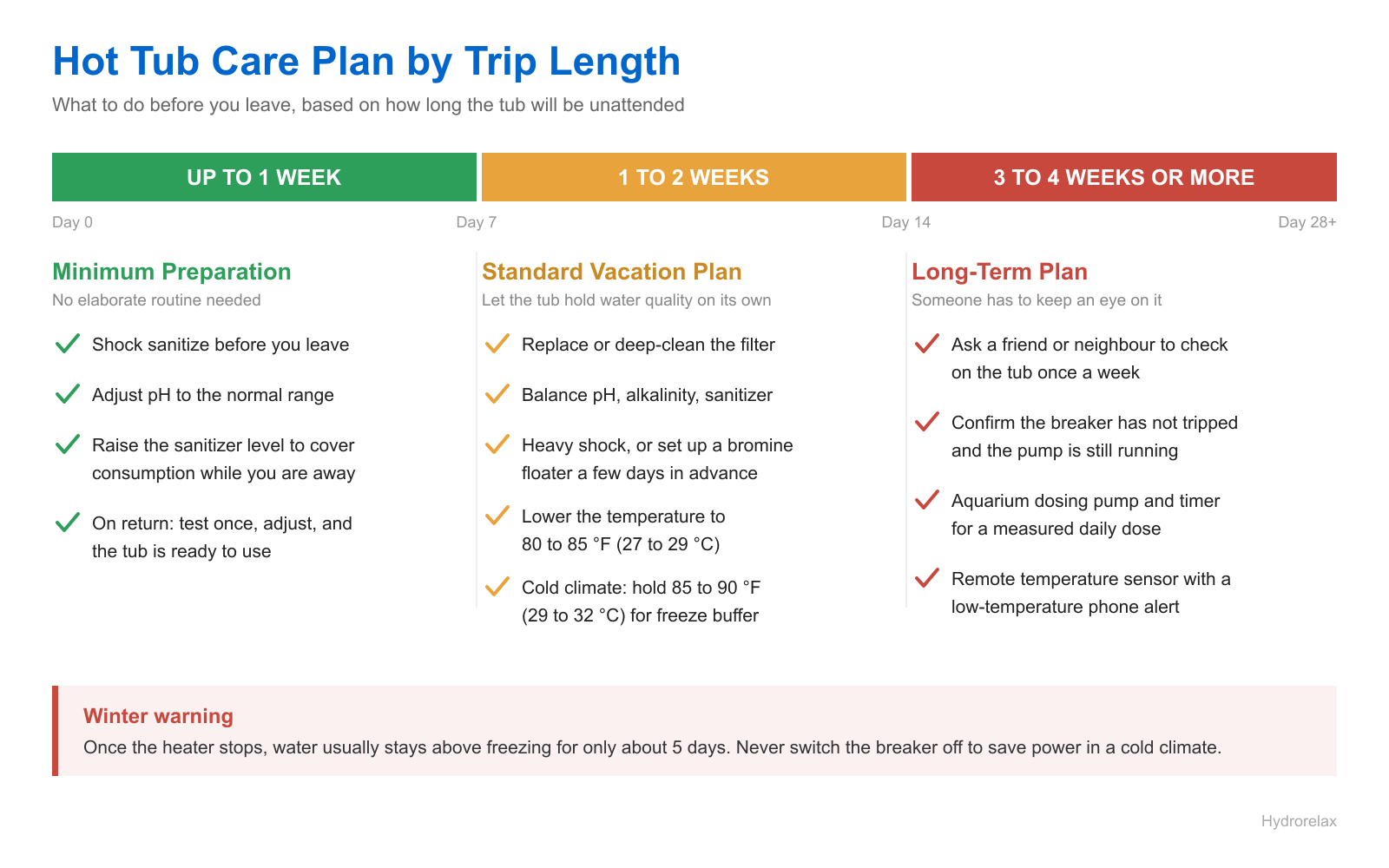
The longer the hot tub will be unattended, the more important it is to plan water care, temperature settings, and a response to equipment problems.
Away for Up to One Week: Minimum Preparation
A short trip usually does not require an elaborate routine, but basic water and equipment checks are still necessary before leaving.
- Perform a shock treatment according to the equipment and water-treatment product instructions.
- Test and adjust the pH to the range recommended for the hot tub.
- Confirm that the sanitizer level is appropriate and is not likely to become depleted immediately.
- Secure the cover and confirm that circulation, heating, and the breaker are operating normally.
When you return, test the water first and add only the treatment products indicated by the results.
Away for 1–2 Weeks: A Standard Vacation Plan
The aim for this period is to keep filtration, circulation, and sanitation as stable as possible without daily maintenance.
- Clean or replace the filter cartridge: Reduce the effect of a dirty filter on water flow and filtration efficiency.
- Balance the water: Test pH, alkalinity, and sanitizer levels before departure, then adjust them according to the equipment and water-treatment product instructions.
- Arrange continuing sanitation: If you use a bromine tablet floater approved for the hot tub, set it up in advance and confirm that the bromine level remains stable. Do not use it for the first time immediately before leaving.
- Lower the temperature: In moderate conditions, the water may be set to 80–85°F (about 27–29°C). If the hot tub has a Vacation Mode or Sleep Mode, follow the manufacturer's instructions for using it.
- Keep more temperature buffer in cold climates: A setting of 85–90°F (about 29–32°C) may provide more time to respond to a heating failure. Combine this with a low-temperature alert, and base the final setting on local weather and the equipment instructions.
Filtration and circulation must also remain operational. To understand the role of the circulation system, read our hot tub circulation pump guide.
Away for 3–4 Weeks or Longer: Arrange On-Site or Remote Monitoring
For a long absence, one treatment before departure is not enough. Decide in advance who will identify a problem and who can reach the hot tub if action is needed.
- Ask a friend, neighbor, or maintenance provider to inspect the equipment regularly.
- Check whether the breaker has tripped, the circulation pump is running, and the water level is normal.
- Install a remote temperature sensor with phone alerts to detect low-temperature conditions.
- Leave the equipment instructions, emergency contacts, and necessary on-site operating guidance.
A remote alert can identify a problem, but it cannot replace on-site action. This is particularly important in cold climates. For more low-temperature maintenance guidance, see our hot tub winter care guide.
The Return-Home Restart Process: When Is the Hot Tub Ready?
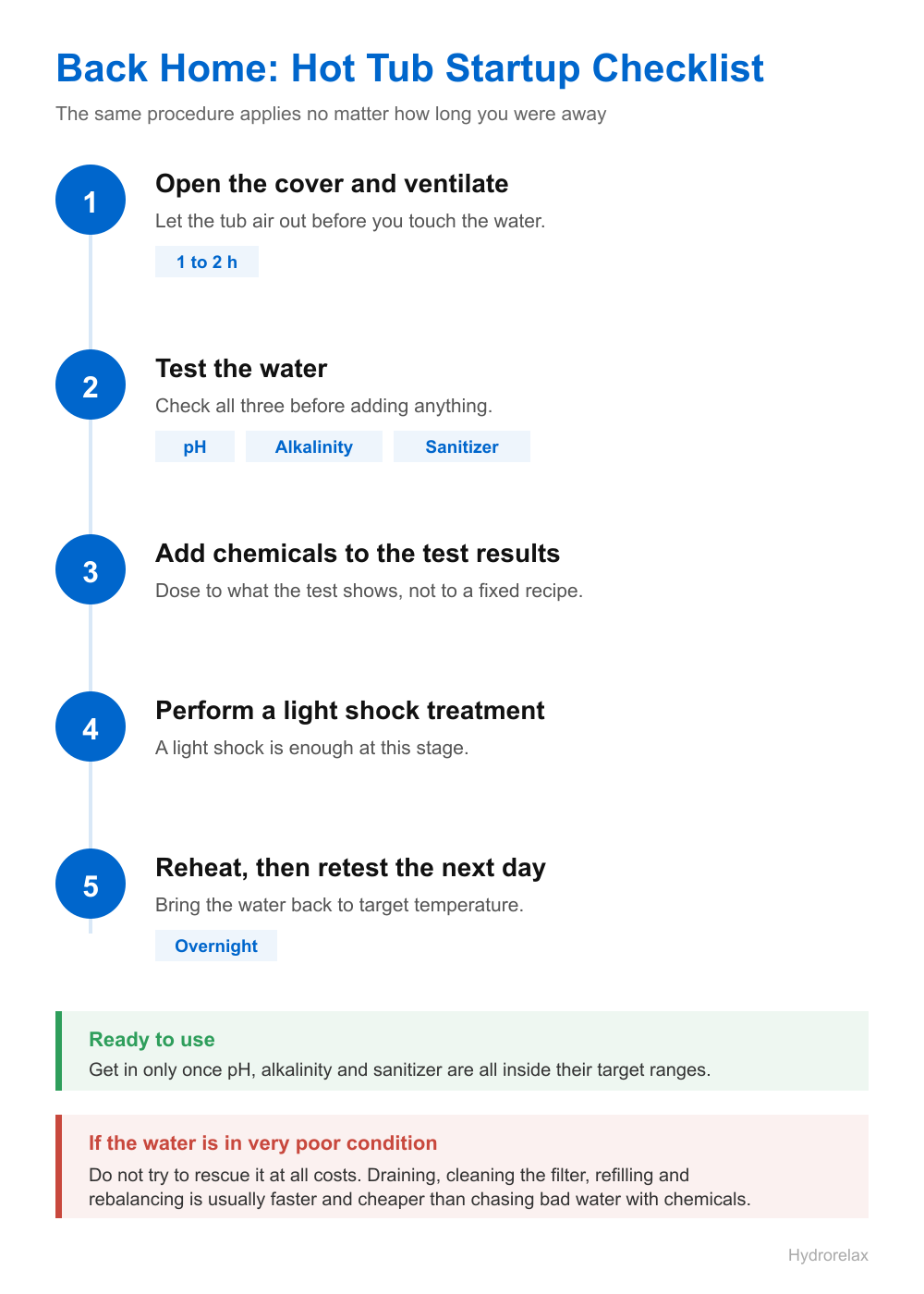
No matter how long you were away, ventilate, test, and adjust the water before restoring the target temperature.
- Open the cover and ventilate the hot tub for 1–2 hours.
- Test the water: Check pH, alkalinity, and sanitizer levels.
- Adjust according to the results: Do not replace actual testing with a fixed chemical dose.
- Perform a light shock treatment if needed.
- Restore the target temperature: After heating, test the water again the next day. Use the hot tub only when the readings meet the equipment and water-treatment product requirements.
Hot Tub Care Before and After Travel: Four Key Takeaways
Coordinating maintenance with your travel schedule can reduce cleaning and restart work when you return.
- Test before short trips: At minimum, check the water, circulation, heating, and cover before leaving.
- Do not copy pool-treatment methods: Sanitizers and dosing methods must be suitable for a hot tub.
- Long absences need a response person: Remote monitoring can provide an alert, but someone must still handle on-site problems.
- Protect the equipment in winter: Do not turn off the power casually, and allow enough time to respond to a low-temperature alert.
Looking Ahead
A practical approach is to put filter cleaning, water testing, water changes, and travel dates on the same maintenance schedule. Before each trip, adjust the plan to the season and length of absence. After returning, restart the hot tub according to test results rather than relying on a one-time dose or a fixed routine.