First published: August 14, 2026 · Last updated: August 14, 2026 · By Shirley · Category: Customer Case Study · Customer: SHMD (Nigeria)
This is a product communication case between Hydrorelax and SHMD, a customer in Nigeria. From the first order in 2020 to the completed deal in 2025, the project was paused for three years because both sides understood the product name differently.
Through this case, Hydrorelax improved the way we confirm customer requirements and match products, and we moved to a more visual, more standardised communication process.
For international buyers, this is a typical and useful reference case. It shows how to find the right product more efficiently in cross-border sourcing, how to reduce the communication cost caused by differences in product naming, and how to match a market requirement to the correct product.
Background of the SHMD Cooperation: How Did the First Order Start?
SHMD placed their first order with us in 2020, after an initial round of discussions.
That order covered water jets, pumps, suctions and bathtub faucets. It also included a split-type steam shower controller system with a small control box.
The customer was satisfied with the product quality and with the overall cooperation, and over the following years they placed repeat orders across several product lines.
By 2022, SHMD told us their market preferred steam shower controllers with a large control box, and asked whether we could supply that version. At that time we only offered the small control box version, and the large box version had been discontinued.
The project could not move forward. But the customer stayed in touch with Hydrorelax and kept watching the market for related products.
The Request Came Back in 2025: What Was the Customer Actually Looking For?
In 2025 SHMD contacted us again. This time we did not judge by the product name alone — we asked the customer for photos first.
They told us that some sellers in their local market were still offering the large control box version, and they asked once more about our split-type steam shower controller.
To give them an accurate answer, we asked the customer to send photos of the products actually being sold in their market, so we could trace the source and the exact model.
Once the photos arrived, we compared them against our own factory records.
What the customer called the "large control box" was not the discontinued split-type product. It was an integrated-type steam shower controller that our factory had been producing continuously. The two products have similar functions, but their structure and naming are different, and that is what caused the earlier misunderstanding.
Once the model was confirmed, we provided the matching solution and quotation, and the order was completed.
If you are comparing control system structures before ordering, our 15 common spa control system questions cover most of the points buyers raise.
Small Control Box vs Large Control Box: What Is the Real Difference?
The difference between the two is not simply size. It is a difference in structure and in naming.
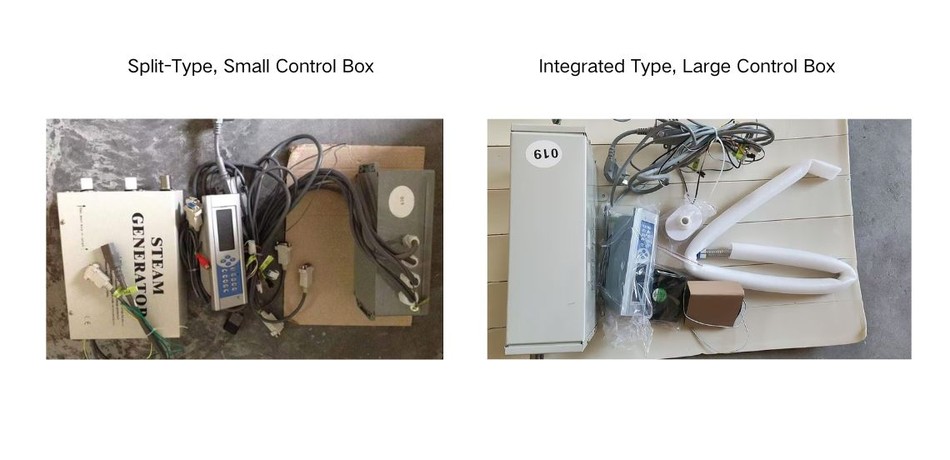
Split-type small control box vs integrated-type large control box for steam shower
For end users, the focus is usually on appearance, installation habits and what the local market is used to. For suppliers, the model number, the product structure and the factory naming system may be completely different. The same applies to controller and control panel compatibility: two units that look alike can still differ in wiring, mounting and control logic.
So the same market requirement can correspond to different product names, and sometimes to a different product structure, depending on the supply chain.
If both sides only exchange text descriptions, it is easy for each side to believe its understanding is correct while the two are in fact discussing different products. Naming is not the only variable — measurement standards differ as well, which is why we also published a guide on how to identify standard dimensions when sourcing spa and bathtub components.
Feedback from SHMD: How Did the Product Perform in Their Market?
After receiving the goods, SHMD gave positive feedback on both product performance and market fit.
The product met their market's demand for the large control box design, and it also solved the product-matching issue that had existed since 2022.
The customer told us that this cooperation helped them find the right product solution, and increased their confidence in our ability to integrate products and respond to requirements.
What We Changed Internally: Why Are Photos More Reliable Than Product Names?
Visual communication is one of the most reliable ways to avoid misunderstandings in sourcing.
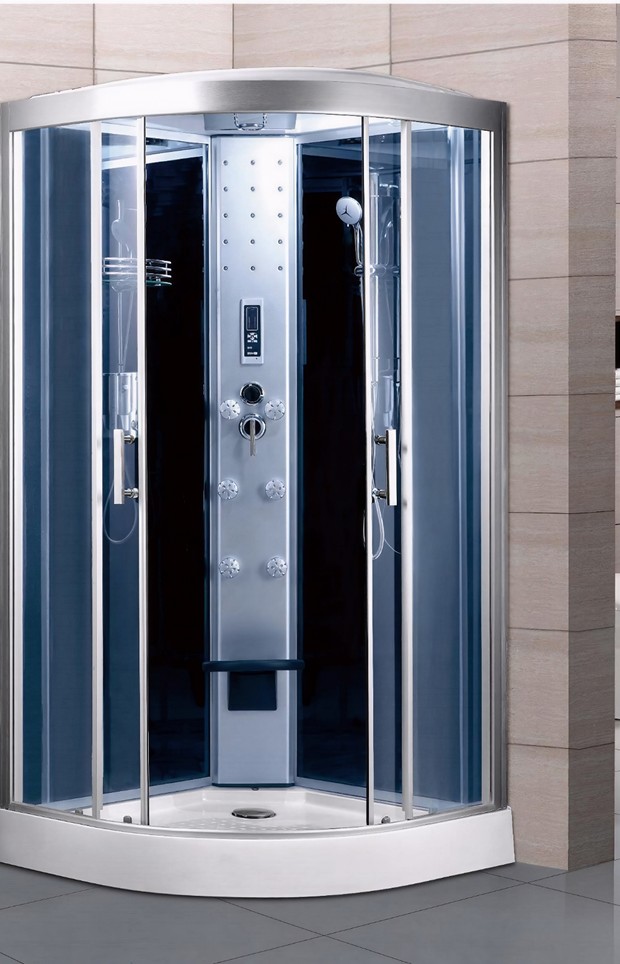
Corner steam shower room with control panel, body jets and handheld shower
If we had relied only on text and verbal descriptions, neither side could have confirmed which product was being discussed. This increases communication cost, delays the project, and can lead to a lost opportunity, even though the product itself was available all along.
Because we asked for photos and cross-checked them against our historical product data and factory records, we found the root cause and solved the customer's sourcing problem.
This case also led us to improve our internal process. For custom requests, special specifications or product replacements, we now ask first for photos, videos, samples, product links and other detailed information.
This type of information is more useful than a product name. It allows us to identify the requirement quickly, coordinate the right supply chain resources, and provide a suitable product solution with fewer rounds of confirmation. We follow the same photo-first method when a shipment goes wrong — see how we solved a damaged shower overhead shipment within 24 hours.
What This Case Tells International Buyers
- A product name is not the product itself. The same function may be named differently in different supply chains.
- Photos, videos and reference links shorten the confirmation cycle more effectively than written descriptions.
- A discontinued model does not mean the requirement cannot be met. The same requirement may correspond to another product structure.
- Staying in contact has practical value. SHMD kept in touch during the three-year pause, which is why the 2025 enquiry could be completed.
Looking Ahead
SHMD's cooperation with us started with bathtub and spa parts in 2020 and now covers steam shower control systems as well. This follows the same path as other long-term partners, such as the five-year OEM SPA cover partnership with SEFM in Southern Europe.
For enquiries where the product name is unclear, we apply the same process: ask the customer for photos and other visual material first, check them against our factory records, confirm the model, then quote.
Work With Us
Hydrorelax supplies spa, bathtub and shower room accessories to buyers worldwide.
If you are looking for a part and are not sure how it is named in our catalogue, you can send a photo, a video, a drawing or a product link. We will check it against our factory records and confirm which product matches, including whether another structure can perform the same function. Where no existing product fits, our spa, bathtub and shower parts customization service covers drawings, tooling and new moulds.
For product matching, customisation or a quotation, contact us.
Hydrorelax FAQ
What services does Hydrorelax provide?
One-stop sourcing and supply chain solutions for spa, bathtub and shower room accessories.
Is Hydrorelax a factory or a trading company?
We have our own factory and 25 years of experience in spa and bathtub component export, with long-term integration of quality supply chain resources.
Can products be customised?
Yes. We support custom designs based on your drawings, including size, materials and functionality. We also have in-house tooling capability, so when an existing product cannot meet the requirement, we can open a new mould for the custom product.
What is the product MOQ?
Spa and bathtub systems start at 20 sets. Other accessories have flexible MOQ options.
What are Hydrorelax's main markets?
We can serve customers in any country worldwide. Our main markets are Europe and America, with long-term partnerships with spa and bathtub brands, some lasting up to 16 years.
Can only describe the part you need with a photo?
Send the photo to us. We will check the product structure against our factory records and provide a matching option.
Contact us
About the Author
This case study was written by Shirley, who has many years of experience in the bathtub and spa industry. She has deep knowledge of bathtub components and focuses on product research and market analysis, helping bathtub brands and manufacturers understand market trends, improve product design and stay competitive.
For more information, you can contact Shirley on LinkedIn.
— End of case study —